


In a candid interview, David Dyer shares his remarkable journey from battling COVID-19, which led to long COVID, to climbing and conquering Kilimanjaro, reflecting on the resilience, self-care, and mindset shifts that propelled his recovery. David's story is a testament to the power of self-compassion and the importance of listening to one's body, offering valuable insights into managing chronic conditions and harnessing personal growth.
Hi David, as you’ve just amazingly climbed Kilimanjaro I think we should start there. What were your motivations behind climbing Kilimanjaro, especially after your COVID-19 recovery?
Six months ago, Kilimanjaro was raised not to me specifically, but just as a general it's happening for charity. When I was asked, my initial response was no. I wasn’t fit enough. They shared their training and various other things they were doing, it stayed on my mind. I started to feel better, with all that I was doing and privately decided that I was going.
I embarked on the Kilimanjaro climb as a personal challenge, a way to test my recovery progress.
To backtrack a bit, I faced severe COVID-19 symptoms - chest pains, difficulty breathing - that led to chronic health issues and it got worse from there. They thought I may have cancer, all sorts of things, but it wasn’t that. And so a long journey of uncertainty and being dismissed, being told I was fine when I wasn't. I had to firstly overcome being ill and reconcile that, you know, being very fit and healthy and active to being able to do nothing. This was challenging.
My recovery was led by my hypothesis that I have chronic inflammation and if I could potentially reduce that, I’d feel better. It involved a rigorous reevaluation of my diet, lifestyle, and mental resilience. No coffee or dairy and I started going to the gym and the spa and slowly, slowly I started to feel better.
The climb represented not just physical recovery but a reclaiming of my narrative.
How did you manage the transition from being critically ill to undertaking such a physical challenge?
My approach was methodical and introspective. I focused on understanding my body's responses to different foods and activities, gradually reintroducing exercise and adapting my diet to mitigate chronic inflammation. This holistic approach, grounded in self-compassion and a day-by-day mindset, was crucial.
“my hypothesis that I have chronic inflammation and if I could potentially reduce that, I’d feel better.”
What role did mindset and daily habits play in your recovery and climb?
My mindset was everything. I adopted a philosophy of doing the best I could each day, without comparison to others or even to my previous capabilities. This acceptance of daily fluctuations in health and ability, paired with a commitment to self-care, I believe, allowed for sustained progress.
What was your experience like with the NHS?
It is hard to criticise the NHS because this was a new condition where there are no treatment protocols. This was compounded by the fact that diagnoses are often preceded by a positive test of some kind, and for long COVID there is none. Therefore it was a process of elimination, and with the often lengthy waiting times, this often left me ‘waiting’. That was hard.
My GP really didn’t know what was wrong, let alone be able to treat it. Could they have been more compassionate? Yes. Could they have agreed to try certain drugs and treatments? Yes. The caveat here is that ‘who takes the risk’ if it doesn’t work or has side effects?
To a degree, I could understand their reluctance. The Long Covid clinic was a bit more helpful, but I still had to push and ‘fight’.
What prompted you to take matters into your own hands and embark on a journey of research and self-discovery?
That I was not getting anywhere, and even when I tried to have a grownup discussion with various Doctors, I wasn’t getting anything other than ‘you are fine, the tests say you are fine’. It was different with the Nurses, Support Staff, and Clinical Nurse Specialists. They were open to a discussion, and agreed with much of what I was saying!
That is what prompted me to investigate further. I was clearly on the right lines, so decided to dig deeper.
I refused to be a victim, and decided that I would try and do everything I could to get better. If the Doctors couldn’t or wouldn’t help me, I would do it myself. Or try to anyway. What did I have to lose?
I’m really interested on how you came to focusing on reducing inflammation for recovery?
My research. A LOT of reading and researching to see what people were looking at and trying. There were a number of studies showing that there was blood-brain crossover, and this was leading to inflammation. In fact, many of the multiple whole body, and cross organ issues were inflammation related, not least the autoimmune aspects. Everywhere I looked, there was inflammation. Or at least inflammation was at or near the root.
I didn’t think it such a radical hypothesis to suggest that chronic inflammation was at play, and that the body was being overwhelmed. It was as if the body was ’stuck’ in the sympathetic nervous state (fight or flight), indeed one of the researched theories was that Long Covid patients are suffering from Dysautonomia.
The reality was that there were (and are) many theories, and many symptoms and conditions that become present. Nobody yet, to my knowledge, has made a definitive synopsis of the causes, so in the absence of that, my theory was simple: Reduce inflammation, and try to help the body move into the parasympathetic nervous state (rest and digest), and see if the body was able to ‘repair’ itself.
And how did you manage your career and employment during this time?
I didn’t. I couldn’t. It was extremely challenging, mentally, physically, and emotionally. I’m sure I suffered from depression, but as I said, I had 2 choices: Be a victim, or be a fighter. I chose to fight.
And so the long road to recovery started. I mean, it started and stopped, and then started again. I had a huge ‘crash’ (physically) in early 2022, when I stopped taking all the supplements I was taking (they were costing me c.£400 per month). They were a sticking plaster. I felt ‘ok’ on them, but not ‘better’. As soon as I stopped them, I had the worst crash. By the summer of 2022, I knew something had to change. I’d kept a food diary for 2 years. I knew my trigger foods (I’m not allergic, I was tested), so that’s when I decided to go ‘all in’ and try my ‘inflammation theory’.
It was all consuming, and required immense discipline. My diet was very restricted. I had been vegan for over 5 years, and started eating some meat and fish again, as well as eggs. I cut dairy, gluten, coffee, and all the trigger foods, plus anything high histamine or histamine releasing. I also stopped ultra processed foods, processed foods and sugar, and started to cook everything from scratch. I was also drinking 4-5 litres of water a day. It was drastic, but it worked!
Add in Spa (Salt Sauna) and gym, plus the determination to ‘do as much as I could on any given day’ (even if that was less than the day before), as well as re-learning to breathe properly and reducing stress, and I had my plan of action.
I also started back on LinkedIn, to try and get my mental health back. Looking, listening, commenting, and ‘meeting’ people. It was good for me to come out of what was basically isolation and see if I still had anything to give. Turns out I did, and do, and so my journey of recovery was physical, mental, and emotional.
In early 2023, I became a Mentor and Business Advisor on the Santander Breakthrough Women Business Leaders’ Programme, and in 10 months helped my Mentee to increase the revenue in her business by 33%! That gave me such a boost! Then in late 2023 I decided to climb Mount Kilimanjaro, so started training for that.
Clearly you are doing a lot better, so that’s amazing and I hope it stays that way. What would you say to anyone else going through a similar experience?
I’m not going to lie, it was very very hard. Probably the hardest thing I have ever done in my life. Harder than climbing Kilimanjaro. That was a walk in the park in comparison! I had to be extremely disciplined. There were no ‘cheat’ days. I didn’t deviate from my new diet. In the beginning, I had 3 months where my wife and son were in Poland visiting family, so I could concentrate just on me. I was also lucky to have a friend of 30+ years who basically dragged me to the spa and gym, but who also knew that I had to rest and recover. He made sure I made food and was ok, but I was determined to get better.
It meant digging very very deep, and keeping going. I found levels of resilience and mental toughness that I didn’t know I had.
What would I say to others? You can do it!
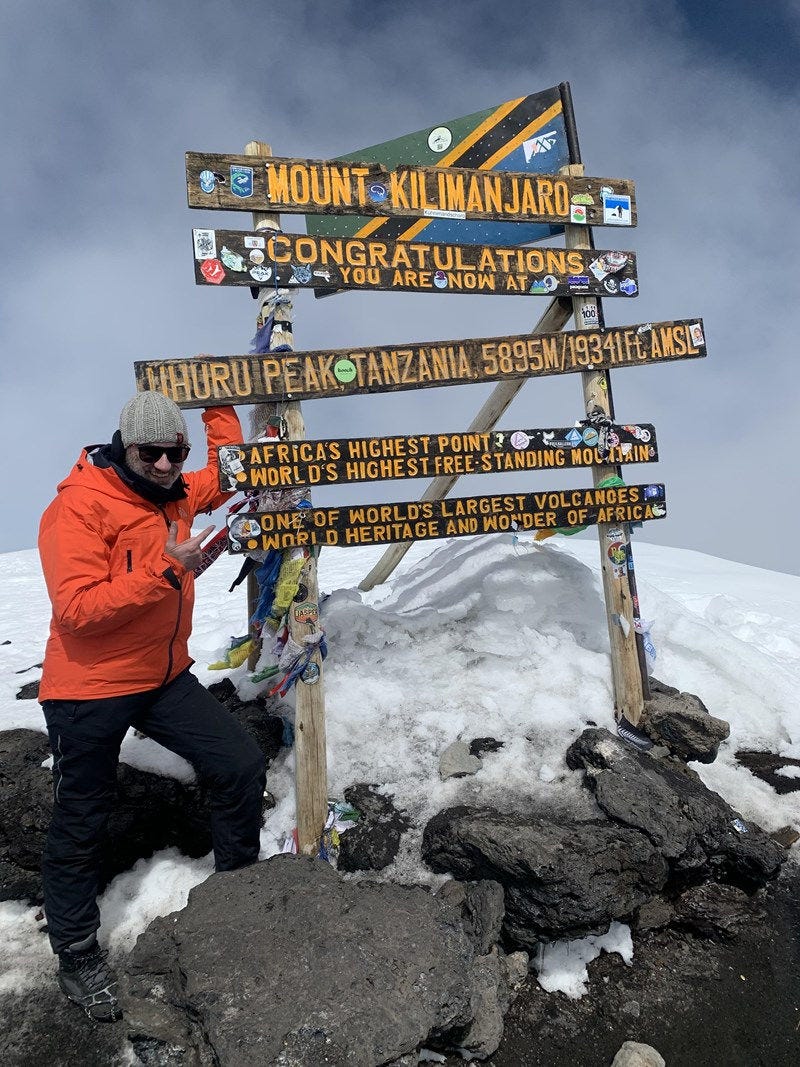
It is possible to recover. Just look at me! I was so ill. I could barely go for a walk, stairs were a challenge, and my breathing was all over the place. Yet in 18 months I was summiting Mount Kilimanjaro with relative ease!
But do what you can do. Don’t compare, and don’t compare to me. This is your recovery and yours alone. Just because xyz worked for me doesn't necessarily mean it will work for you.
Mindset is key. You have to really want it. Be positive. Never give up. If you are determined, you can do it, you can get your life back. But be prepared to forge your own path, don’t wait for others to fix you. That said, finding a very compassionate (and knowledgeable) Doctor can help, preferably one that is interested in Long Covid and Mast Cell Activation Syndrome. And be prepared for setbacks. The recovery isn’t linear, there is no ‘magic pill’, not yet anyway.
I was ill for nearly 4 years, and for 2.5 of those years I was extremely sick. Only now can I say I am ‘back’. Even then, I am not ‘cured’, I just manage it very very well. I am still disciplined with food, etc., but now I am bursting with energy. I am also not the same person as I was 4 years ago. Understandably. These things change you. They can make you. I am a better person now, and I am excited to see what the future holds as I make my first real steps back into the real world.
This interview with David not only highlights the physical and emotional challenges associated with long COVID but also offers hope and strategies for those navigating their own health journeys. David's story is a powerful reminder of the human capacity for resilience, the importance of self-care, and the potential for remarkable recovery.
Thanks David for sharing your journey!
So good on you! I agree that mindset was everything to be able to adjust to new eating, exercise, healing habits. David is an icon!