


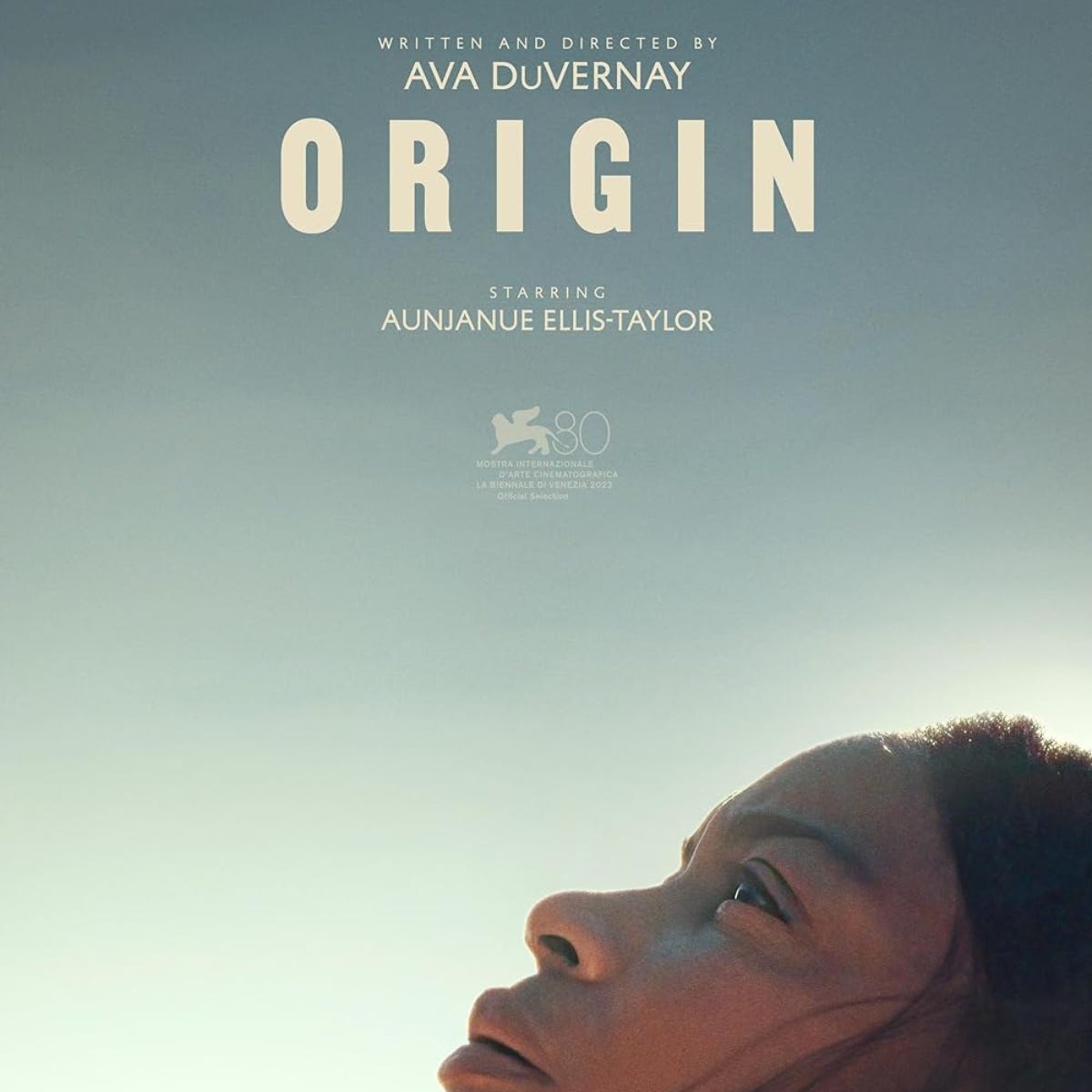
When I stumbled upon the trailer for Origin at the end of last year—courtesy of the YouTube algorithm—and saw it was an Ava DuVernay film, I was instantly captivated. I immediately alerted my friends: “WE MUST SEE IT.” Fortunately, my partner, attuned as always to my interests, reminded me yesterday that it had been released. By happy coincidence, I was meeting a friend at the West Norwood Library, which, conveniently, has a cinema attached. Everything aligned perfectly for me to catch a screening.
To my surprise, I found myself completely alone in the screening room. This unexpected solitude prompted a mental note to investigate further—why was such a promising film meeting an empty auditorium?
Ava DuVernay's reputation for selecting poignant themes, coupled with her mastery in production and visual storytelling, had set my expectations high. Now, the empty seats around me seeded a pang of nervous anticipation.
Origin draws from Isabel Wilkerson’s Caste: The Origins of Our Discontent, a title I hadn't yet read but was deeply curious about, especially given its exploration of the caste system—a concept I associate closely with India. As a South Asian raised in the UK, detached from Indian culture yet familiar with it through the works of Arundhati Roy and others, the topic resonated with me.
Isabel Wilkerson, a journalist and the first African-American woman to win the Pulitzer Prize in journalism, authored Caste in a year marked by George Floyd's death. The book, a bestseller, aims to reframe American—and indeed global—perspectives on race and racism by delving into their root causes through the metaphor of caste. Wilkerson draws parallels between the societal lowest, from Dalits to African-American slaves to Jews persecuted by Nazi Germany, suggesting a commonality in their varied experiences of oppression.
Ava DuVernay had approached Isabel, after her third reading of the book, having not quite understood it the first time, but she began to feel the writer in the words and later understood. Her questions to Isabel: “tell me your story, tell me what was going on when you wrote this?” and her answers paved a clear vision. Ava’s adaptation of this non-fiction work into a narrative film artfully weaves the deeply personal journeys within Wilkerson's text, Wilkerson’s own challenges, creating a poignant, visually striking experience that transcends its source material.
The film Origin vividly captures Isabel Wilkerson's journey of pain, resilience, and determination, largely due to Aunjanue Ellis-Taylor's remarkable lead performance—astonishingly her first. Her role is beautifully complemented by Niecy Nash. There's a captivating familiarity to Aunjanue Ellis-Taylor that eludes precise description, yet her presence on screen is utterly magnetic. Her joy becomes my joy, and her sorrow deeply mirrors my own, creating an indelible connection that transcends the screen.
Despite my usual composure, the film moved me to tears. Alone, I felt my emotions more freely, pondering whether the solitude amplified my response or simply allowed it to surface unguarded.
Curiosity about the film's subdued reception led me to discover its challenging production phase. Unfazed by conventional hurdles, Ava DuVernay pursued alternative and self-funding methods for the project. She received vehement support from friends, including Guillermo Del Toro—a director I deeply admire—who not only validated her vision but also provided encouragement throughout the process.
Despite lacking Oscar recognition and facing skepticism even about its festival chances, Origin made a historic impact at the Venice Film Festival, receiving a lengthy standing ovation and marking DuVernay as the first black woman to compete in its 80-year history.
Ava DuVernay's work, including 13th, When They See Us, and Selma, consistently leaves a lasting impression. Origin is no exception. It invites viewers on a journey to understand humanity’s interconnectedness and to find clarity in our complex world.
It’s unfortunate that Origin did not get the same marketing budget that Barbie did, but I have seen it and now I feel compelled to shout about it before it becomes completely invisible - I believe this is what we call word of mouth. It turns out that Aunjanue did exactly that too, when the movie came out in January, she went to cinemas and handed out flyers to promote the movie.
This is my call to action: see Origin, delve into DuVernay's body of work, and let these stories inspire a deeper understanding and connection with the world around us.
Fascinating write up, I must see this. Thanks for sharing your unique perspective Tash