


Before diving in, I need to lay some groundwork first:
1. A chronic health condition is considered a disability if it has a long-term effect on your normal day-to-day activity, but not all disabilities are chronic health concerns. Chronic health concerns and disabilities can be visible or invisible (also known as hidden, but the better term is non-apparent).
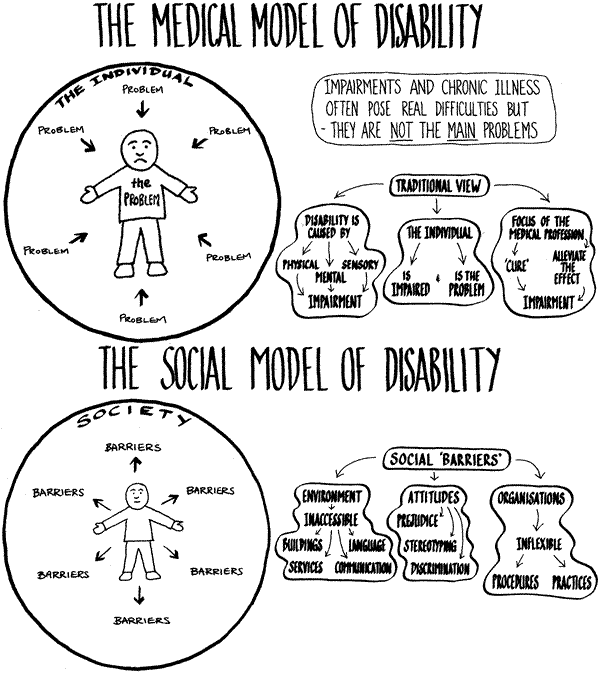
2. I believe in the social model of disability, which seeks to redefine disability to refer to the barriers caused by the way society is run and organised. I love a diagram, and one of the best ones I've seen is:
So, I have a chronic autoimmune condition and I consider myself to have a non-apparent disability, but I've only just started talking about it in this way. However, do my family, friends, or colleagues consider me to have a disability?
The perception of a disability varies depending on who you are talking to and how you talk about it. Consider my partner; their allergies are getting more severe and harder to control over time. I think it's true that it is not generally considered or perceived as a disability. However, after frequent visits to A&E this past month, the lived experience is not so different to mine.
It is no wonder that it is challenging to navigate the workplace or job market.
It's difficult to judge how employers will perceive it, perhaps a weakness, and in this context, there is more at stake (or at least it can feel like that).
The process I went through last year involved asking myself the following (and taking a breath): Note that my condition affects my joints, mainly my hands.
✔️Are the side effects from my current medication manageable?
✔️Do I have a good support network?
✔️If my condition suddenly worsens, is there a plan with my consultant?
✔️Does my job involve using my hands (i.e. typing on a computer)?
✔️Is diversity and inclusion part of their values?
✔️Do I feel comfortable expressing myself?
✔️Is there flexibility?
❌Does my condition currently affect my ability to do the job and get work done?
Ultimately, I felt comfortable disclosing my condition to my employer within the first month of being hired.
My advice to those with a non-apparent disability that may affect their work is to establish the company's values as quickly as possible, ask them directly, or do some digging. Establish whether you feel comfortable talking about any differences, i.e. your queerness or your obsession with Dolly Parton. The checklist above offers guidance to create your own, not just when applying for jobs but throughout your career.
My advice to employers is to be intentional and create a safe space so that employees feel comfortable talking about their differences, who they are and how they like to work. You can do this by talking about your differences or oddities - you are in a position of power, so lead by example. Naturally, employees may then feel comfortable disclosing a condition. The sooner you do this, the quicker you'll understand how to get the best work out of your employee and the faster they'll feel comfortable.
As a person with a non-apparent disability, I can choose when to disclose my condition, as it's not immediately apparent. Still, the process of disclosing my disability is daunting.
I hope my advice is helpful and, at the very least, helps you feel less alone.
really good post - intentional and clear communication is key