


In today's fast-paced and distraction-filled world, maintaining focus has become more challenging yet increasingly essential. Whether it's pursuing a PhD, tackling an MBA, or simply navigating daily tasks, the ability to concentrate deeply impacts our productivity, learning, and overall well-being.
This is made a further challenge if you have low-energy (less time) or you have ADHD, for example.
Drawing on insights from experts like Nir Eyal and Barbara Oakley, this article explores effective strategies to enhance focus and transform how we work and learn.
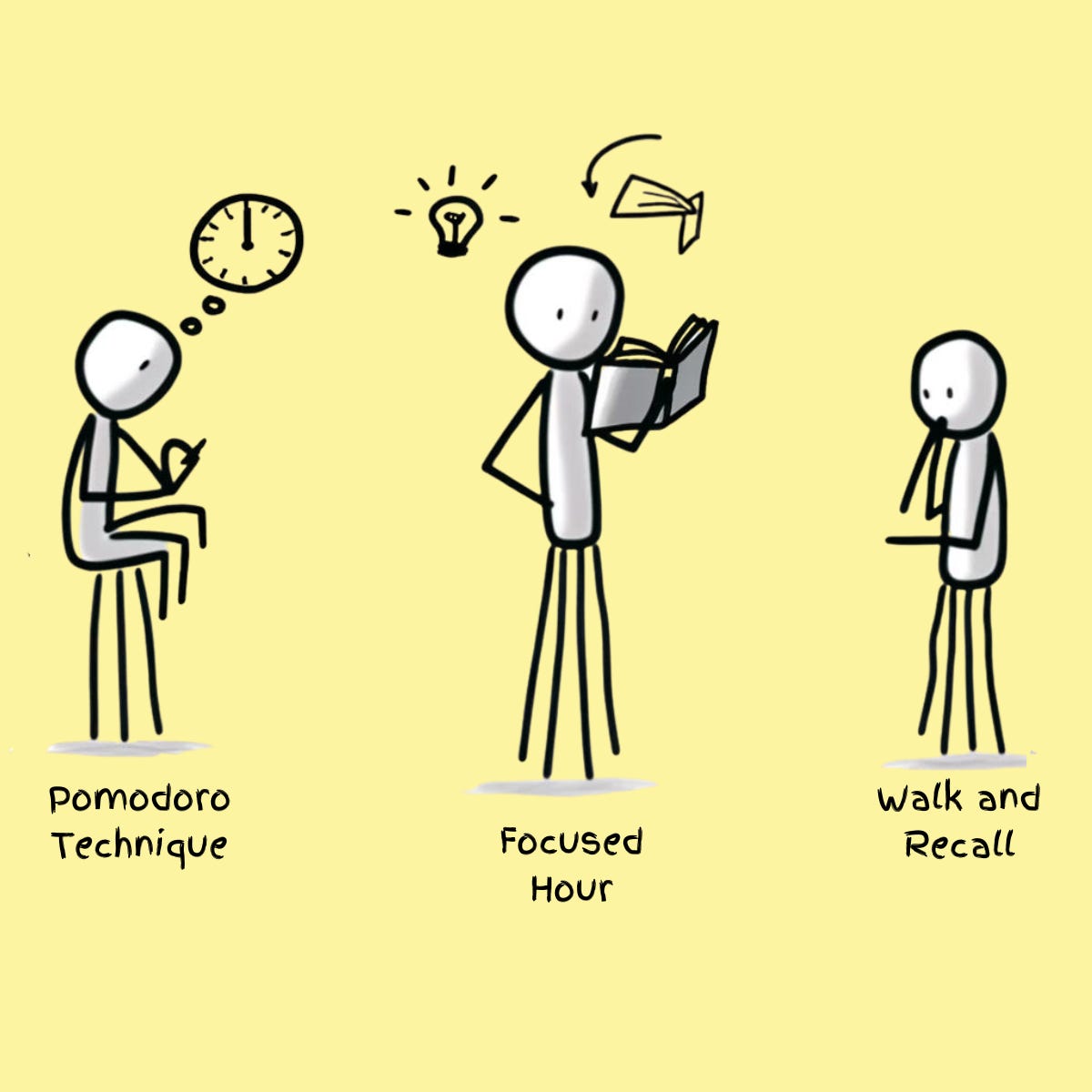
Understanding Focus
Focus, at its core, is the ability to direct our attention to a specific task while filtering out distractions. It's a skill that can be developed and refined with practice and the right techniques. The benefits of improved focus extend beyond just productivity; they encompass enhanced creativity, better problem-solving abilities, and increased satisfaction with our work.
Strategies for Enhanced Focus
1. The Pomodoro Technique for Immediate Deadlines
The Pomodoro Technique, developed by Francesco Cirillo, is a time management method that breaks work into short, focused intervals (traditionally 25 minutes), separated by short breaks. Here’s how to apply it:
Work on a task for 25 minutes (you can use phone as a stopwatch).
Take a 5-minute break to recharge.
After four cycles, take a longer break of 15-30 minutes (I recommend going for a walk).
This technique is particularly effective for tasks with immediate deadlines, creating a sense of urgency and a rhythm that helps sustain concentration.
2. Scheduled Focus Time for Distant Deadlines
For tasks with more distant deadlines, setting aside dedicated focus time each day is crucial. Nir Eyal suggests dedicating an uninterrupted hour to your work, with a twist:
Keep a notepad beside you to jot down distracting thoughts and associated feelings.
Review these notes after your focus session to address any pertinent issues and understand your distraction triggers.
This method not only helps in maintaining focus by not letting those thoughts and feelings override you in that moment, but also in gaining insights into personal procrastination patterns and emotional responses. Over time this trains your brain to stop being triggered in the moment and delays any immediate reaction to it, which will likely distract for a while i.e. googling something or sending an email.
Below is a photo of my notepad, capturing distracting thoughts. Here is a fun challenge, what was the time-span for this mental clutter? 20-minutes? 1-hour? 2-hours?

Only 20 minutes! Some days this is my reality and that’s ok.
What did I learn?
I got more honest about my feelings as I went on and after 20 minutes of doing the act, I was able to focus, without a distracting thought, for the next 30 minutes. So, it really does work.
3. Learning How to Learn: Enhancing Cognitive Focus
Barbara Oakley's "Learning How to Learn" offers invaluable strategies for enhancing cognitive focus through understanding how our brain processes information. Key takeaways include:
Use chunking to break down complex information into manageable units.
Apply recall techniques during breaks to reinforce learning and identify areas needing more focus. I usually scribble it out, record a voice note if I'm walking or call a friend that doesn't mind listening!
Understand the diffuse mode of thinking, allowing for creative problem-solving by stepping away from focused work. This is especially handy when you just can't calculate something, take another look at your notes and the basics, step away and try again.
4. Creating a Focused Environment
Beyond these strategies, creating an environment conducive to focus is essential:
Minimise external distractions by curating a clean, organised workspace.
Use apps or tools to block digital distractions.
Inform colleagues or family members of your focused work times to reduce interruptions.
I struggle with noise, my trick is noise-cancelling headphones with nothing playing or a low-fi playlist.
5. Embracing Rest and Mindfulness
Incorporating rest and mindfulness into your routine can significantly enhance focus. Regular breaks, meditation, and mindful practices help reset your attention, reduce stress, and improve cognitive function. The impact of a good night's sleep on your memory and overall ability to focus cannot be overstated. This is easier said than done, I know. For an exam, I usually make peace with myself that my life, for that short period of time, will revolve around studying and resting, with exploration and immediate gratification taking a backseat.
The Journey to Improved Focus
Mastering focus is not an overnight achievement but a journey of experimenting with different strategies to find what works best for you. By integrating these techniques into your daily routine, you can improve not only your productivity but also your creativity, learning efficiency, and overall sense of fulfilment.
Remember, the goal is not to eliminate distractions entirely but to manage your attention in a way that aligns with your priorities and values. As you embark on this journey, be patient with yourself and celebrate the small victories along the way.